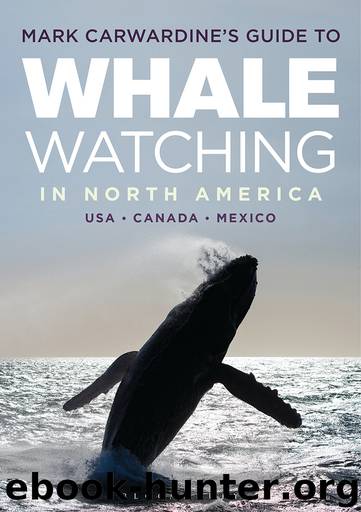
Mark Carwardine's Guide to Whale Watching in North America by Mark Carwardine
Author:Mark Carwardine
Language: eng
Format: epub
ISBN: 9781472930705
Publisher: Bloomsbury Publishing
Published: 2017-03-14T04:00:00+00:00
California
Overview
Main species: Gray Whale, Blue Whale, Fin Whale, Humpback Whale, Minke Whale, Killer Whale, Pacific White-sided Dolphin, Northern Right Whale Dolphin, Risso’s Dolphin, Short-beaked Common Dolphin, Long-beaked Common Dolphin, Common Bottlenose Dolphin, Dall’s Porpoise, Harbor Porpoise.
Occasional species: Sei Whale, Bryde’s Whale, Sperm Whale, Short-finned Pilot Whale, Striped Dolphin.
Other wildlife highlights: Sea Otter, Northern Elephant Seal, Harbor Seal, Northern Fur Seal, Steller Sea Lion, California Sea Lion, Black-footed Albatross, Pink-footed Shearwater, Buller’s Shearwater, Sooty Shearwater, Black-vented Shearwater, Ashy Storm Petrel, Black Storm Petrel, Least Storm Petrel, Sabine’s Gull, Tufted Puffin, Pigeon Guillemot, Rhinoceros Auklet, Surf Scoter, Leatherback Turtle, Great White Shark, Thresher Shark, Ocean Sunfish.
Main locations: boat trips: Crescent City, Fort Bragg, Mendocino, Sausalito, San Francisco, Berkeley, Half Moon Bay, Morro Bay, Avila Beach, Santa Barbara, Ventura, Oxnard, Malibu, Marina del Ray, Redondo Beach, San Pedro, Long Beach, Huntingdon Beach, Balboa, Newport Beach, Laguna Beach, Dana Point, Oceanside, San Diego; Monterey Bay (Monterey, Moss Landing, Santa Cruz); aerial whale watching: Santa Barbara, Oxnard; land-based whale watching: Cabrillo National Monument (San Diego), Pigeon Point Lighthouse (south of Half Moon Bay), San Simeon and Montaña de Oro State Park (between Monterey and Santa Barbara), Point Vicente Interpretive Center and Rancho Palos Verdes (south of Los Angeles), Point Reyes National Seashore, Bodega Head and Sonoma Coast State Park (north of San Francisco), and many more.
Types of tours: two-hour to full-day boat trips; multi-day expedition cruises; kayaking tours; aerial whale watching; land-based whale watching.
When to go: year-round; mid-December–May (sometimes June) for migrating Gray Whales; Blue Whales May–January (mainly July–September); Humpback Whales May–November; Killer Whales year-round, mainly December–May (peak April–May).
Regulations and guidelines: NOAA Guidelines for Viewing Marine Mammals; US Federal Regulations; National Marine Sanctuaries Act; regulations within specific National Marine Sanctuaries; Marine Mammal Protection Act (1972).
Wildlife species are listed systematically (not in order of abundance) and frequency of sightings varies with location and season.
Download
This site does not store any files on its server. We only index and link to content provided by other sites. Please contact the content providers to delete copyright contents if any and email us, we'll remove relevant links or contents immediately.
The Lonely City by Olivia Laing(4799)
Animal Frequency by Melissa Alvarez(4467)
All Creatures Great and Small by James Herriot(4314)
Walking by Henry David Thoreau(3956)
Exit West by Mohsin Hamid(3824)
Origin Story: A Big History of Everything by David Christian(3691)
COSMOS by Carl Sagan(3621)
How to Read Water: Clues and Patterns from Puddles to the Sea (Natural Navigation) by Tristan Gooley(3466)
Hedgerow by John Wright(3356)
How to Read Nature by Tristan Gooley(3338)
The Inner Life of Animals by Peter Wohlleben(3316)
How to Do Nothing by Jenny Odell(3297)
Project Animal Farm: An Accidental Journey into the Secret World of Farming and the Truth About Our Food by Sonia Faruqi(3219)
Origin Story by David Christian(3198)
Water by Ian Miller(3181)
A Forest Journey by John Perlin(3070)
The Plant Messiah by Carlos Magdalena(2929)
A Wilder Time by William E. Glassley(2860)
Forests: A Very Short Introduction by Jaboury Ghazoul(2837)
